
What "Damaged or Missing Seal" Is Actually Protecting You From
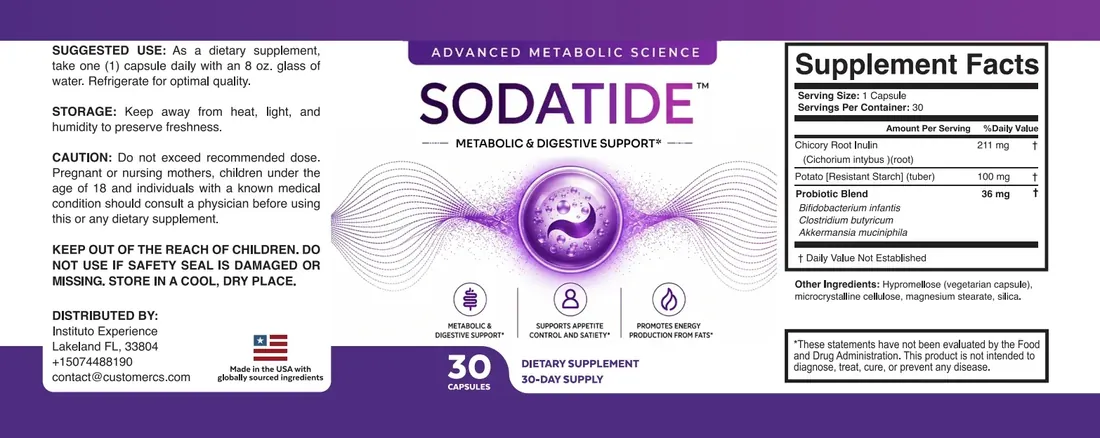
The Sodatide label prints a capital-letters warning: DO NOT USE IF SAFETY SEAL IS DAMAGED OR MISSING. That kind of seal became standard after poisoning incidents in the 1980s led the FDA to require tamper-evident packaging on over-the-counter drugs. A dietary supplement like Sodatide is not legally covered by that specific drug rule, but most supplement brands use a similar seal anyway as a basic safety practice. A broken seal does not prove a product is fake. It means the container cannot be confirmed unopened since it left the factory.
What exactly does the Sodatide label say about the seal?
The warning sits in the capital-letters block on the left panel of the Sodatide label, next to two other safety lines. Transcribed exactly, it reads:
- Printed warning
- KEEP OUT OF THE REACH OF CHILDREN · DO NOT USE IF SAFETY SEAL IS DAMAGED OR MISSING · STORE IN A COOL, DRY PLACE
- Where it appears
- Left panel of the wrap label, below the suggested-use line
- Type size
- Same capital, bold-weight type as the other two warnings on that line
Three separate instructions share one line: keep the bottle away from children, check the seal before use, and store it somewhere cool and dry. They are grouped together because they are all pre-use or storage checks rather than dosing instructions. The full transcription, with every other line on the bottle, is on the Sodatide Supplement Facts page.
Where did tamper-evident packaging rules come from?
The short version: a product-tampering crisis, not a supplement-industry decision, is why bottles like this one carry a seal at all. In the fall of 1982, seven people in the Chicago area died after taking Tylenol capsules that had been laced with potassium cyanide after they reached store shelves. The packaging at the time gave no outward sign that a bottle had been opened and re-closed. The case triggered a nationwide recall, new state and federal criminal laws against product tampering, and a fast regulatory response.
The FDA issued an interim rule in November 1982 requiring tamper-resistant packaging for most over-the-counter (OTC) human drug products, then finalized and tightened that definition over the following years. A 1998 Federal Register final rule spells out what counts as an acceptable tamper-evident feature for OTC drugs, down to the specific statement manufacturers must print telling buyers how to recognize an intact package (FDA Federal Register final rule, 1998). Shrink bands, foil induction seals, blister packs and breakable caps all trace back to this period.
That history explains the wording on the Sodatide label. The phrase "safety seal is damaged or missing" is close to boilerplate language that spread across the OTC drug and supplement industry after the 1980s, not a line written specifically to describe this product.
Does the federal seal rule even apply to a dietary supplement?
Not directly, and this is the part most labels do not explain. The 1982–1998 tamper-evident packaging requirement described above is written for OTC human drug products under FDA drug regulations. Sodatide is sold as a dietary supplement, which the FDA regulates under a different part of the law. Supplements fall under 21 CFR Part 111, the current Good Manufacturing Practice (cGMP) rule for dietary supplements. Part 111 requires that packaging and labels be controlled to prevent mix-ups, contamination and mislabeling, but it does not mandate the specific drug-style tamper-evident seal and warning statement that OTC drug rules require.
In practice, the distinction rarely shows up on the shelf. Most supplement brands, including this one, adopted the same shrink bands, foil seals or safety rings as OTC drugs anyway, because the manufacturing lines, contract packagers and retail buyers that handle supplements largely grew up alongside the drug-packaging rules. The seal on a Sodatide bottle is a voluntary, industry-standard safety practice layered on top of the separate, less prescriptive Part 111 requirements, not a specific drug-law obligation.
What a tamper-evident seal can tell you, and what it can't
What an intact (or broken) seal actually proves, next to what it does not
| Question | Does a seal answer it? |
|---|---|
| Was the cap opened after the factory sealed it? | Yes — this is the one thing the seal is built to show |
| Do the capsules inside match the label's ingredient list? | No — a seal says nothing about what is inside |
| Was the product made in the facility the label names? | No — an intact seal can be applied anywhere |
| Has the product passed independent lab testing? | No — see the testing & quality page for what is and is not published |
| Is this bottle genuine and not counterfeit? | No — counterfeiters can and do copy seals |
| Is the product still within its usable window? | No — that is a separate date or batch question |
A seal is a narrow tool. It is built to answer exactly one question — has this specific container been opened since it left the line — and nothing else. Treating an intact seal as proof of authenticity, lab testing or ingredient accuracy goes beyond what the feature is designed to do.
Why this warning matters more for something you swallow
Tamper-evident features exist on all kinds of packaging, from software boxes to electronics, but the warning carries more weight on a product meant to be swallowed daily. If a capsule container were opened and something harmful introduced, the risk is direct and internal in a way it is not for most other tampered goods. That asymmetry is exactly why the 1982 poisonings targeted a medicine capsule and why the resulting rules focused first on ingestible drug products before supplements followed the same packaging conventions.
There is also a design trade-off worth knowing about. A 1985 commentary in the Journal of the American Geriatrics Society examined whether tamper-resistant features created a new problem: packaging secure enough to deter tampering can also be difficult for older adults or anyone with limited hand strength to open (Sherman, 1985). The piece is decades old and specific to OTC drug packaging of that era, but the underlying tension — security versus usability — is still why packaging engineers test seals on real users rather than just lab machines.
What should you do if a Sodatide bottle's seal looks damaged or missing?
Follow the label. It says not to use the product if the safety seal is damaged or missing, and that instruction should be treated as a hard stop rather than a judgment call. Before opening, look at the cap and the neck band or foil seal (whichever this batch uses) for tears, gaps or a loose fit compared with what you would expect from a factory-sealed bottle.
- Do not use the capsules if the seal is broken, missing, or looks tampered with in any way.
- Keep the bottle, the box and any packing materials rather than discarding them immediately.
- Photograph the seal and the lot information before contacting anyone, so there is a record of what you received.
- Reach out through the contact page, which lists the order line and both inboxes, to report the issue and ask about a replacement or refund.
- If you ever want to understand what a lot or batch code on a bottle can and cannot confirm, the batch verification page covers that separately.
None of this means the product is unsafe by default. It means the one piece of evidence the packaging is designed to give you — an unbroken seal — is no longer available, so the label asks you to stop rather than guess.
A six-point checklist for judging any supplement's seal
Identify the seal type
Shrink band around the cap, foil induction seal under the cap, or a breakable ring — know what this product normally uses.
Check for a clean, continuous line
A factory seal should look uniform. Gaps, re-glued edges or uneven cuts are signs to stop and look closer.
Test the cap resistance
A properly sealed bottle usually gives slight resistance on first opening. A cap that turns with no resistance at all is worth noting.
Compare with the label's own description
Some labels describe their seal feature directly. Sodatide's does not describe the seal type, only the instruction not to use it if broken.
Remember what a seal cannot confirm
It cannot confirm potency, purity or authenticity — only that the container was not opened before you got it.
Know who to contact and what to keep
Save the bottle and note the lot details before contacting the seller if anything looks wrong.
What this seal warning does not tell you about Sodatide specifically
It is worth being direct about the gap between a generic safety instruction and product-specific proof. The seal warning on the Sodatide label is the same category of language used across the OTC and supplement industry since the 1980s. It does not tell you which facility packaged this particular bottle, whether the capsules were independently lab-tested, or how the probiotic blend's potency was verified before the seal went on. Those are separate questions covered on the ingredients page and the testing & quality page, and in both cases the label discloses some details and leaves others unpublished.
What the seal does confirm, when intact, is narrow but still useful: nobody opened this specific container between the factory and your hands. That is a real, if limited, safety signal, and it is the reason the warning exists on this label at all.
Seal warning questions
What does “do not use if safety seal is damaged or missing” actually mean?
It means the label is asking you to stop and not take the product if the tamper-evident feature on the cap or neck of the bottle is torn, loose or absent. The instruction exists because an intact seal is the main way a manufacturer can show a container has not been opened since it left the factory.
Is Sodatide legally required to have a tamper-evident seal?
Not under the specific federal rule that covers over-the-counter drugs. That rule applies to drug products. Sodatide is a dietary supplement, regulated under a separate manufacturing rule (21 CFR Part 111) that requires controlled packaging but does not mandate the same drug-style seal. Most supplement brands use one anyway as standard practice.
Why did tamper-evident packaging become standard in the first place?
A string of poisoning deaths linked to tampered medicine capsules in Chicago in 1982 led the FDA to require tamper-resistant packaging on over-the-counter drugs. The practice spread to many other ingestible products, including dietary supplements, over the following years.
Does an intact seal prove a bottle of Sodatide is genuine?
No. An intact seal shows only that the specific container was not opened after it was sealed. It does not verify where the product was made, confirm lab testing, or rule out counterfeiting, since seals themselves can be copied.
What should I do if my bottle's seal looks damaged?
Do not use the capsules. Keep the bottle and packaging, photograph the seal, and contact the seller through the contact page to report the issue and ask about a replacement or refund.
Does the seal warning tell me anything about ingredient potency?
No. A seal is only a tamper indicator. It says nothing about whether the printed amounts of inulin, resistant starch or the probiotic blend match what is actually in the capsule.
Where can I read the exact wording printed on the label?
The full label, transcribed line by line including this warning, is on the Sodatide Supplement Facts page.
Ready to try Sodatide?
Order from the U.S. authorized merchant, keep your order email, and you are covered by the 60-day money-back guarantee. Questions first? The contact page has the order line and both inboxes.
Keep reading
Supplement facts
The full Sodatide label transcribed line by line, including every warning.
Read more →Testing & quality
Every seal explained, what is published, what is missing, and how to store the capsules.
Read more →Batch verify
What a lot number and CoA code can and cannot confirm about a bottle.
Read more →Product
Buying
Trust & help
- Reviews
- Testing & quality
- About us
- Editorial method
- Contact
- FAQ
- Guides
- Gut health guide
- Supplement checklist
- Blog
Legal
Buy SodatideTracking and refunds: see the contact page.
