
Sodatide Ingredients: The 3 Actives in Each Capsule
Each Sodatide capsule holds 347 mg of actives: two fibers and a three-strain probiotic blend.
That is 211 mg chicory root inulin, 100 mg potato resistant starch and 36 mg of Bifidobacterium infantis, Clostridium butyricum and Akkermansia muciniphila. The shell is vegetarian, with no baking soda or caffeine.
See the label typed out on the Supplement Facts page.
What are the Sodatide ingredients at a glance?
Seven items in total: three that do the work and four that hold the capsule together.
- Chicory root inulin
- 211 mgPrebiotic fiber from chicory roots
- Potato resistant starch
- 100 mgStarch that acts like fiber
- Probiotic blend
- 36 mg3 strains, CFU not published
- Total actives
- 347 mgPer 1-capsule serving
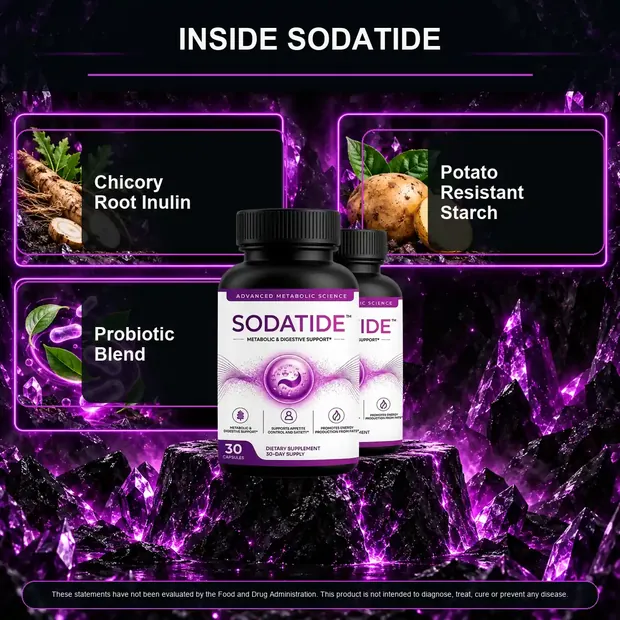
Sodatide has three active ingredients, and the label lists an amount for each one. Two are prebiotic fibers. One is a blend of three probiotic strains.
Prebiotics are food for gut bacteria. Probiotics are the bacteria themselves. The idea is to add a little of both in one capsule each day.
Four more items help build the capsule. They are the shell, a filler, a flow agent and an anti-caking agent. Each one is explained further down.
Every amount here comes from the Sodatide Supplement Facts panel. Nothing on this page is guessed from marketing copy.
Chicory root inulin (211 mg): what does it do in Sodatide?
The biggest part of the formula, and the best-studied fiber in it.

Chicory root inulin is the largest ingredient in each capsule. It is a prebiotic fiber, which means your body cannot digest it but your gut bacteria can.
Inulin is a chain of fructose units. Your stomach and small intestine lack the enzymes to break those links. So the fiber passes through and reaches the colon mostly intact.
In the colon, helpful bacteria such as Bifidobacteria ferment it. A review of 26 trials found that prebiotics like inulin raised feelings of fullness and lowered blood sugar after meals (Kellow et al., 2014). Effects on body weight were mixed in that review.
- Plant source
- Cichorium intybus, the root of the chicory plant
- Type
- Inulin-type fructan, a soluble fiber
- Per capsule
- 211 mg, about 61% of the active weight
- Tolerance
- Up to 10 g a day was well tolerated in a controlled study (Bonnema et al., 2010)
Inulin is also the ingredient most likely to cause gas early on. At 211 mg, that risk is small, because studies of stomach comfort used 5 to 10 g at a time.
Potato resistant starch (100 mg): the smallest fiber dose
A second fiber that feeds a different group of gut bacteria than inulin does.
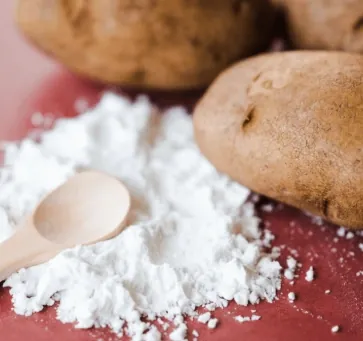
Resistant starch is starch that escapes digestion in the small intestine. It then behaves much like fiber and becomes food for bacteria in the colon.
Potato is a rich source of this type, known as type 2 resistant starch. Cooking breaks the granules open, so supplements use raw potato starch that has not been heated.
Gut bacteria such as Ruminococcus bromii start the breakdown. In a two-week study, potato resistant starch raised butyrate in many people, but not in all of them (Baxter et al., 2019). The response depended on which bacteria each person already had.
In another study, a large dose spread across one day lowered how much people ate at later meals (Bodinham et al., 2010). Hunger ratings did not change, though.
What is in the Sodatide probiotic blend?
Three species in 36 mg. Each has its own research, and none of it used this exact product.
The probiotic blend weighs 36 mg and holds three named species. The label calls it a blend, so it does not show how much of each is inside. It also does not publish a CFU (colony forming unit) count.
Bifidobacterium infantis
B. infantis is a Bifidobacterium first found in the guts of breastfed babies. Adults carry less of it. It is good at breaking down complex sugars and fibers.
The best-known adult trial used one specific strain, 35624, at 100 million CFU a day for four weeks. That dose beat placebo on bloating and bowel comfort in women with IBS (Whorwell et al., 2006). Results belong to that strain only, and the Sodatide label does not name a strain number.
Clostridium butyricum
C. butyricum is a spore-forming bacterium. Spores are a tough, resting form that can survive stomach acid better than many other probiotics.
Its name comes from butyrate, the short-chain fatty acid it makes. A 2021 review describes a long history of probiotic use and calls for more human trials (Stoeva et al., 2021).
Akkermansia muciniphila
Akkermansia lives in the mucus layer that lines the gut. It feeds on that mucus and helps keep the layer renewed. Few supplements carry it, which makes it the most unusual part of the formula.
In a small three-month trial, adults with extra weight took 10 billion cells a day (Depommier et al., 2019). The pasteurized form was safe and improved insulin sensitivity. Weight and body fat changed only a little. Whether the Akkermansia in Sodatide is live or pasteurized is not stated on the label.
What are the other ingredients in Sodatide capsules?
Four helpers that let a machine fill 30 identical capsules.
The four other ingredients on the Sodatide label and what each one does
| Other ingredient | What it is | Why it is there |
|---|---|---|
| Hypromellose | A plant-based material made from cellulose, also called HPMC | Forms the capsule shell. It makes the capsule vegetarian, unlike gelatin shells. |
| Microcrystalline cellulose | Purified plant cellulose, usually from wood pulp | A filler. It adds bulk so each capsule is filled to the same level. |
| Magnesium stearate | A magnesium salt of stearic acid, a common fat | A flow agent. It stops the powder from sticking to the filling machines. |
| Silica | Silicon dioxide, a mineral found in sand and many plants | An anti-caking agent. It soaks up moisture so the powder does not clump. |
These four items do not add any health effect. They are standard in capsule supplements, and each appears in small amounts. The label lists them in this order: hypromellose (vegetarian capsule), microcrystalline cellulose, magnesium stearate, silica.
If you avoid any of them for personal reasons, you now know exactly where each one sits. The Sodatide fit check covers diet needs such as vegetarian and gluten free.
What is not in Sodatide?
What you will not find is useful too. Many fat-burner products lean on stimulants, and Sodatide does not.
No baking soda
Sodium bicarbonate is not on the label. The name is a brand name, not a recipe.
No stimulants listed
There is no caffeine, green tea extract, synephrine or any other stimulant on the panel.
No caffeine
Nothing in the capsule should keep you awake. You can take it in the morning without a buzz.
No gelatin shell
The capsule is hypromellose, so it contains no animal gelatin.
No added flavors or colors listed
The other-ingredients line has four items, and none is a flavor, sweetener or dye.
No hidden extras
Everything in the capsule should appear on the panel. If a site lists more, it is not quoting the label.
Sodatide ingredients vs. the doses used in research
The ingredients are well chosen. The amounts are far smaller than what the studies used.
Sodatide per-capsule amounts compared with the amounts used in human studies
| Ingredient | Per capsule | Dose in studies | Share of study dose |
|---|---|---|---|
| Chicory root inulin | 211 mg | 5–10 g tolerated (Bonnema et al., 2010); 16 g oligofructose for fullness hormones (Cani et al., 2009); 20 g inulin (Baxter et al., 2019) | About 1–4% |
| Potato resistant starch | 100 mg | 28–34 g a day (Baxter et al., 2019); 48 g in one day (Bodinham et al., 2010) | Under 0.5% |
| Akkermansia muciniphila | Part of 36 mg | 10 billion cells a day for 3 months (Depommier et al., 2019) | Cannot tell; count not published |
| Bifidobacterium infantis | Part of 36 mg | 100 million CFU a day of strain 35624 (Whorwell et al., 2006) | Cannot tell; strain and count not published |
| Clostridium butyricum | Part of 36 mg | Review only, no set dose (Stoeva et al., 2021) | No benchmark |
How do the Sodatide ingredients work together?
The formula pairs food for bacteria with the bacteria themselves.
Fibers travel down
Inulin and resistant starch pass the stomach and small intestine without being digested.
Bacteria get food
In the colon, native bacteria and the added strains ferment the two fibers.
Useful by-products
Fermentation makes short-chain fatty acids such as butyrate, which colon cells use for fuel.
This pairing is called a synbiotic: prebiotic fiber plus probiotic bacteria in one product. The fiber gives bacteria something to eat on the way through.
Two fibers can feed more kinds of bacteria than one. Inulin favors Bifidobacteria, while resistant starch favors starch-eating species. For the full chain of events, see how Sodatide works. For daily directions, see how to take Sodatide.
Sodatide ingredients questions
What are the main Sodatide ingredients?
There are three active ingredients. One capsule contains 211 mg of chicory root inulin, 100 mg of potato resistant starch and 36 mg of a three-strain probiotic blend. The blend contains Bifidobacterium infantis, Clostridium butyricum and Akkermansia muciniphila.
Does Sodatide contain baking soda?
No. Baking soda (sodium bicarbonate) is not on the label. The name may sound like soda, but the formula is two prebiotic fibers and three probiotic strains in a vegetarian capsule.
Does Sodatide contain caffeine or stimulants?
No caffeine or stimulant appears anywhere on the label. The only other ingredients are hypromellose, microcrystalline cellulose, magnesium stearate and silica. None of these is a stimulant.
How many CFU are in the Sodatide probiotic blend?
The CFU count is not published. The label gives the blend weight, 36 mg, but not how many live cells it holds or how the weight splits between the three strains. You can ask the order desk, but we have not seen a figure.
Does Sodatide use live or pasteurized Akkermansia?
The label does not say. In the main human study, both forms were tested, and the pasteurized form gave the clearer results. Without that detail, the Sodatide Akkermansia cannot be matched to the study form.
Is magnesium stearate safe?
Magnesium stearate is a common flow agent used in small amounts to keep powder from sticking to machines. It is widely used in capsules and tablets. If you have a specific sensitivity, show the label to your doctor.
Is the Sodatide capsule vegetarian?
Yes. The shell is hypromellose, a plant-based material the label calls a vegetarian capsule. The brand also shows vegetarian, gluten-free and dairy-free seals.
Why is the dose so small compared with studies?
One capsule can only hold a few hundred milligrams. Fiber studies used grams, often 5 to 34 g a day. That is why we call Sodatide a light daily add-on and suggest eating fiber-rich food as well.
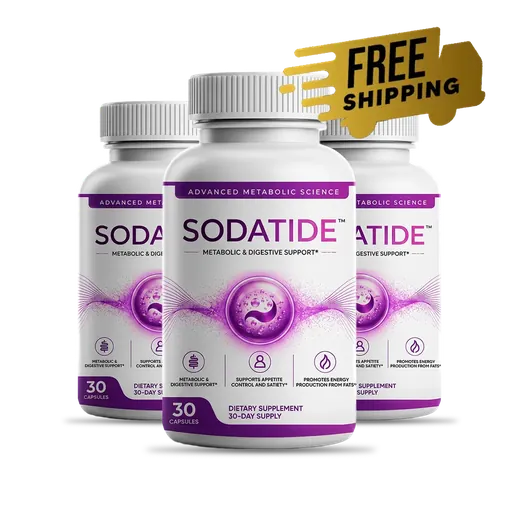
Ready to try Sodatide?
Order from the U.S. authorized merchant, keep your order email, and you are covered by the 60-day money-back guarantee. Questions first? The contact page has the order line and both inboxes.
Keep reading
Supplement facts
The whole label typed out, plus how to read a supplement facts panel.
Read more →How it works
The gut science behind the formula, step by step, with the dose caveat.
Read more →Akkermansia explained
What two human trials found about Akkermansia, and why the CFU count on a label matters.
Read more →