
Soda Tide Ingredients: Every Item on the Sodatide Capsule Label, Explained
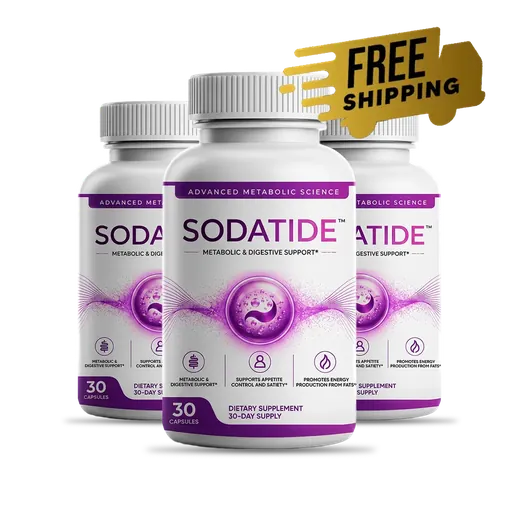
Soda Tide ingredients are three actives in each Sodatide capsule: 211 mg of chicory root inulin, 100 mg of potato resistant starch and a 36 mg probiotic blend of Bifidobacterium infantis, Clostridium butyricum and Akkermansia muciniphila. That adds up to 347 mg of actives. The other ingredients are hypromellose (the vegetarian capsule), microcrystalline cellulose, magnesium stearate and silica. There is no baking soda on the label, and one capsule a day is the full serving.
What are the Soda Tide ingredients?
The Sodatide ingredients come straight from the Supplement Facts panel on the bottle. One serving is one capsule, and a bottle holds 30 servings. Here is the full list, in the order the label gives it.
Sodatide ingredients per 1-capsule serving, from the label
| Ingredient | Amount per capsule | What it is |
|---|---|---|
| Chicory Root Inulin | 211 mg | A prebiotic fiber from the root of the chicory plant |
| Potato Resistant Starch | 100 mg | Starch that resists digestion and acts like fiber |
| Probiotic Blend | 36 mg | Bifidobacterium infantis, Clostridium butyricum, Akkermansia muciniphila |
| Other ingredients | Not listed by weight | Hypromellose (vegetarian capsule), microcrystalline cellulose, magnesium stearate, silica |
You can see the panel itself on the Sodatide Supplement Facts page. If our page and your bottle ever disagree, follow the label and tell us.
Chicory root inulin: what does 211 mg do?
Chicory root inulin is a prebiotic fiber. It passes through the stomach and small intestine without being digested. In the colon, gut bacteria ferment it, and that fermentation is the main idea behind the formula.
The amount is small. Human studies on inulin used about 5 to 20 g a day, and a tolerance study found up to 10 g a day of native chicory inulin was well tolerated, with gas and bloating as the most common complaints (Bonnema et al., 2010). One capsule gives 0.211 g. Our guide to inulin and resistant starch lists each study and its dose.
Potato resistant starch: what does 100 mg do?
Resistant starch is starch that your own enzymes cannot fully break down, so it acts like fiber and reaches the colon. There it feeds a different group of bacteria than inulin does.
Research doses were much larger again: 28 to 48 g a day in the studies on this site. In one trial, 28 to 34 g a day of potato resistant starch raised butyrate, and the response depended on each person's gut bacteria (Baxter et al., 2019). The capsule holds 0.1 g, so see it as a small daily extra, not a research dose.
What is in the 36 mg probiotic blend?
The blend names three species: Bifidobacterium infantis, Clostridium butyricum and Akkermansia muciniphila. Together they weigh 36 mg per capsule.
- CFU count: not published, so the blend cannot be compared with research doses.
- Amount of each strain: not published.
- Live or pasteurized Akkermansia: the label does not say. The fridge instruction suggests the blend is handled as live, but that is not stated.
- Research dose for Akkermansia: a 2019 trial used 10 billion cells a day for 3 months (Depommier et al., 2019).
The Akkermansia research guide covers that trial in detail and explains why the CFU count matters.
What are the other ingredients for?
The "other ingredients" line lists the parts that make a capsule work on a machine and in your hand. None of them is an active ingredient.
- Hypromellose: the plant-based capsule shell, which makes it a vegetarian capsule.
- Microcrystalline cellulose: a filler that brings the powder up to a full capsule.
- Magnesium stearate and silica: flow agents that help the powder move through filling machines.
Sodium bicarbonate is not on this line or anywhere else on the label. The full answer to the name mix-up is in Is Sodatide baking soda?
How do Sodatide ingredients compare with research doses?
Sodatide amounts next to daily doses used in studies cited on this site
| Ingredient | Per capsule | Research doses |
|---|---|---|
| Chicory root inulin | 211 mg | About 5 to 20 g a day |
| Potato resistant starch | 100 mg | About 28 to 48 g a day |
| Akkermansia muciniphila | Part of 36 mg | 10 billion cells a day (Depommier et al., 2019) |
| Whole probiotic blend | 36 mg | CFU not published, so no comparison is possible |
We print this gap on purpose. The fiber in one capsule is a small share of what studies used, and no study has tested this exact formula. One capsule a day is also the label maximum, so the answer is not to take more.
What does the Sodatide label not tell you?
- The CFU count and the amount of each strain.
- The manufacturer and factory address. The label names a distributor only: Instituto Experience, Lakeland, FL 33804.
- A lab certificate. Lot SOD-26/SO-2885 and CoA SOD-2885-26-SO are reference codes, not published lab results.
For everything else, the Sodatide home page and the ingredients page keep the full list in one place.
Soda Tide ingredients: reader questions
How many mg of ingredients are in one Sodatide capsule?
One capsule holds 347 mg of active ingredients: 211 mg of chicory root inulin, 100 mg of potato resistant starch and a 36 mg probiotic blend.
Is the Sodatide capsule vegetarian?
Yes. The capsule shell is hypromellose, a plant-based material, and the label lists it as a vegetarian capsule.
Does Sodatide contain baking soda?
No. Sodium bicarbonate does not appear anywhere on the Sodatide label. The actives are two prebiotic fibers and a three-strain probiotic blend.
Does the label show a CFU count?
No. The probiotic blend is listed by weight, 36 mg, with no CFU count and no amount for each strain.
Ready to try Sodatide?
Order from the U.S. authorized merchant, keep your order email, and you are covered by the 60-day money-back guarantee. Questions first? The contact page has the order line and both inboxes.
Keep reading
Ingredients page
Every ingredient, its amount per capsule and how it compares with research doses.
Read more →Inulin vs. resistant starch
How the two fibers differ, which foods have them, and the doses studies used.
Read more →Is Sodatide baking soda?
The name sounds like soda, but the label lists fiber and probiotics.
Read more →